
In this email
- Monthly Video Energy reading for December 2024
- My musings on The most wonderful time of the year.
- Gus the Bus does Italy Video – Hot Springs and an operatic Diva (capital intentional) extraordinaire.


CHRISTMAS!
OK – be honest now!
Do you love it?
Do you hate it?
Or do you just kinda get through it?
You know I have a sneaky love of wandering the tree decoration isles.
I buy a new decoration every year in memory of something I care about.
Our tree is, as a result, full of memories and I like to torment our kids by reminding them of the significance of various decorations every year.
(Oh how they look forward to that – tee hee!)
I love connecting with the origins of things and so I thought I’d explore the real origins of our traditional modern day Christmas.
I honestly thought it was the Pagan Yule festival.
But it turns out, that it’s the Roman festival of Saturnalia that gives us the earlier origin of many of our Christmas traditions.
Saturnalia, was an ancient Roman festival and holiday that was celebrated from the 17th to the 23rd of December, dating back all the way back to the 3rd and 4th Centuries,
The Romans celebrated by decorating their homes with evergreen garlands to represent everlasting life in the dark days, with silly gift giving, lighting lots of candles, making merry and of course…..feasting and drinking.
Masters also traditionally waited on slaves and servants as it was seen as a time of freedom for everyone.
Yule came a bit later, it’s ancient pagan roots dating back to the 9th century.
Yule is associated with the winter Solstice and is rooted the Celtic religion and is informed by Germanic and Norse (Viking) traditions.
The name Yule is from the Norse word hweol, meaning wheel, celebrating the sun as a great wheel of fire that rolls towards and then away from the earth.
Yule gave us the tradition of kissing under the mistletoe and the 12 days of Christmas tradition.
Celtic tradition believed that the the yule log should be kept alight over the 12 days between the Solstice and the New Year because the sun stands still in these darkest 12 days.
Yule also celebrates by bringing evergreen decorations into each home, gift giving and merry making, feasting and of course candles and fire.
What’s lovely, is that both of these ancient festivals are jointly foundational in the celebration we now call Christmas.
With enduring, treasured traditions we all still share and enjoy thousands of years later,
Christmas was first called Christmas the year 567 when the season of Christmastide was pronounced as a sacred season.
This brings us full circle, as the date of Christmas was decided on, not because it was actually the date Jesus was born.
Instead it was a practical choice to solve the calendar clashes of the Roman empire solar calendar with the lunar calendars of their eastern provinces.
As the world changed, the old polytheistic religions faded and were absorbed into the new Christian order.
But the traditions of Saturnalia and Yule still dominate our modern day Christmas.
All three naturally merging together while remaining amazingly unchanged in their basic premise
It would seem, we human beings have, across time, instinctively celebrated life, coming together and partying as the year draws to a close and days are at their shortest.
So, no matter what religion or name you put on it, celebrating together, evergreen pine trees and ivy, feasting, gift giving and light in the form of candles or fire seems non-negotiable.
This is actually rather lovely in the light of this months energy update, with a message from spirit that seems to wish us just that.

Italy sure has been an amazing ride. Watch here as I bask in the hot springs of Saturnia and we explore the beautiful city of Lucca and get blown away by a spectacular operatic diva.
As always, please leave me a little comment and….like and subscribe of course!
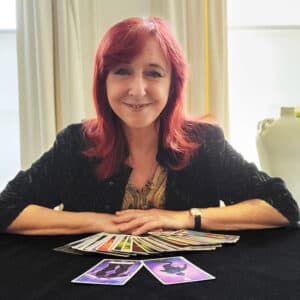
I’m always here for a reading if you need one.
30 mins or 1 hour Readings via Zoom
or WhatsApp Video